About Marias’s grandfather

We would like to tell you about Maria’s grandfather. Her grandfather, like her, was born in Donetsk. Today, Maria has only one grandfather left alive, on her father’s side. Her grandfather is now 73 years old, he is a pensioner. After graduating from the institute, he worked in the regulatory authorities of the Donetsk region his entire working life. During his work as an auditor, he checked and inspected not only the region, but also some Union Republics of the former Soviet Union.
Grandfather was born in the city of Snezhnoye, Donetsk region, in the family of a disabled miner, a sailor of the Black Sea Fleet, a participant in the Great Patriotic War. After graduating from high school, he began his career as a car mechanic, then as a miner in a mine. He served in the Soviet Army. In the Army, he was also actively involved in sports. At the USSR Missile Forces Boxing Championship, he fulfilled the standard of a candidate for Master of Sports of the USSR.

But the most important thing is that Masha’s grandfather is a creative person, he is a poet and a writer. He has written and published more than 10 collections of poems, stories and fairy tales in various publishing houses in Donbass. He dedicated many of them to his wife and granddaughter.

This is how unusual Maria’s grandfather is in terms of creativity. But otherwise, he is an ordinary person, just like us:
- gets up at 7 am
- does morning prayer
- does exercises
- has breakfast.
- is engaged in creativity and his household chores throughout the day.
Grandfather visits the club of creative intelligentsia of the city of Donetsk, which is located in the Central Library. He reads new poems written by him there. He willingly attends art exhibitions, concerts and performances of poets – bards. He tries to live a full creative and ordinary life.

Recently, in 2022 and 2023, grandfather wrote and published three collections of poems under the same title “Drobyshevo”: about the surrounding nature, beautiful winters; hard rural labor, a terrible war, about love for a woman.
Grandfather spent two years in the village of ‘Drobyshevo’ working on a large rural plot of land, tending the garden and growing vegetables: tomatoes, cucumbers, eggplants, onions, carrots, cabbage, garlic and herbs. And in the garden: apples, pears, plums, cherries, grapes; melons: magnificent watermelons and melons.
Of course, it is not easy for Masha’s grandfather, he is sick. He complains to doctors about headaches, joint pain, blood pressure. Quite recently, he began to include Chinese healing methods of Shiatsu, acupressure, tapping with a wooden stick on the body in his exercise cycle, but there is no Chinese literature that could be used to fully study. He asks Maria to look for this literature in Moscow. I think she will find it soon. Grandfather dreams of visiting China, getting to know the sights of the country, visiting the famous Great Wall of China.
Now it is worth telling about the peculiarity of Masha’s grandfather. Every time he works on a new work, he likes to brew himself tea. For him, this is a special ritual that gives him inspiration. But he drinks tea not only while writing, he also loves to have tea with the whole family. Especially when Maria comes to him on vacation. But the traditions of Russian tea drinking differ in many ways from the traditions of other countries.
Tea traditions in Russia – where they came from and how they developed.
In Russia, tea drinking has a long and rich history, playing an important role in culture and social life. In brief, the traditions look like this:
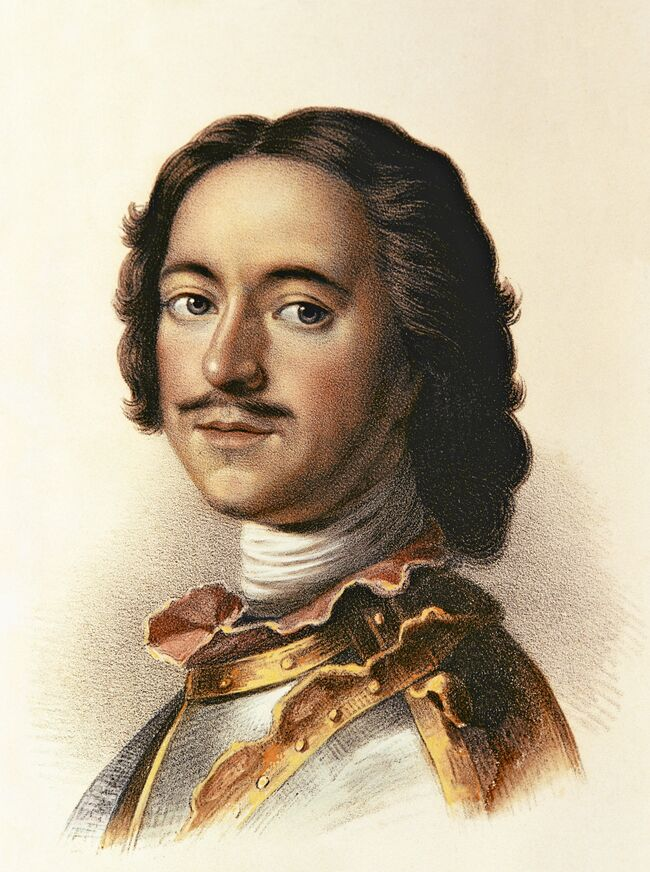
– History of its appearance in Russia. Tea appeared in Russia at the end of the 17th century, when the first tea parties were held by Tsar Peter I. Soon tea became a popular drink in Russian society.
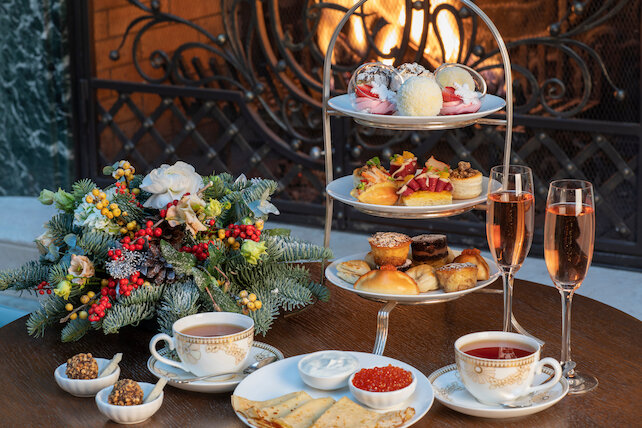
– Russian sweet table. The tradition is often associated with the concept of a “tea table”. This is a dinner event during which a wide range of snacks and sweet dishes are served, accompanied, of course, by tea. Various types can be presented here – from black to green.

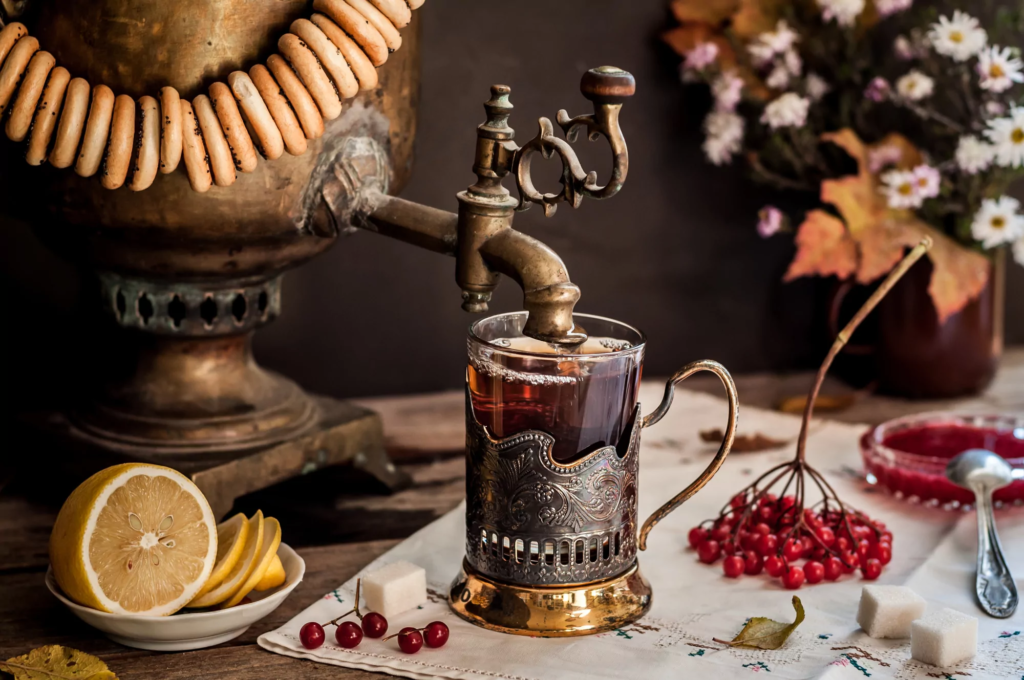
– Samovar. Traditional Russian utensils for boiling water, play a key role in Russian tea parties. It is often decorated with patterns and serves as a central element when serving.

– Brewing. It is done with a teapot or samovar. To maintain the optimal temperature of the brew, the teapot is covered with a handmade “babka”(teapot cover).

– Tea in Russian literature and art. It played a significant role in Russian literature and art. Many works, such as “The Master and Margarita” by M.A. Bulgakov, describe tea ceremonies as part of everyday life.
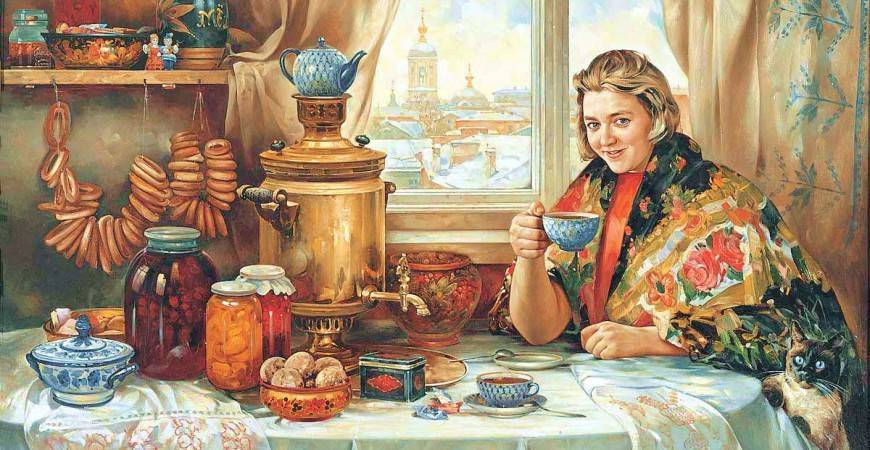
– Tea houses and establishments. In modern Russia, there are many themed houses and cafes where people can enjoy a variety of teas, snacks and desserts. Such places usually create a cozy atmosphere, and the choice can vary from traditional varieties to exotic mixes.

– Russian black tea. Can be served with honey, lemon or jam. Often chosen for its strong flavour, which pairs well with traditional Russian appetizers.
– Tea parties with family and friends. Often associated with socialising. Families and friends gather together in the evening or on weekends to share experiences, discuss news and enjoy a cup of hot drink.

– Christmas and holiday traditions. During festive periods such as Christmas, tea drinking becomes especially festive. Families gather over a cup of tea, exchange gifts and give each other warmth and attention.
– Tea in Russian folk medicine. Russian culture traditionally believes in the healing properties of tea. Different types are considered beneficial to health, and in some cases tea is used as a remedy for colds and other ailments.

Overall, tea traditions in Russia represent hospitality, warmth and socialising. Tea is an integral part of the Russian way of life and continues to play an important role in the country’s everyday culture and an element of public life, symbolizing hospitality and comfort. The centuries-old traditions remain an important part of Russian culture today.
Problem
Sometimes Maria’s Grandfather faces problems that are related to his tradition of brewing tea before working with books. He often has to search for cups and mugs throughout the apartment. In addition, he is especially inspired by vintage and antique cups. He has a huge collection of porcelain tea sets.
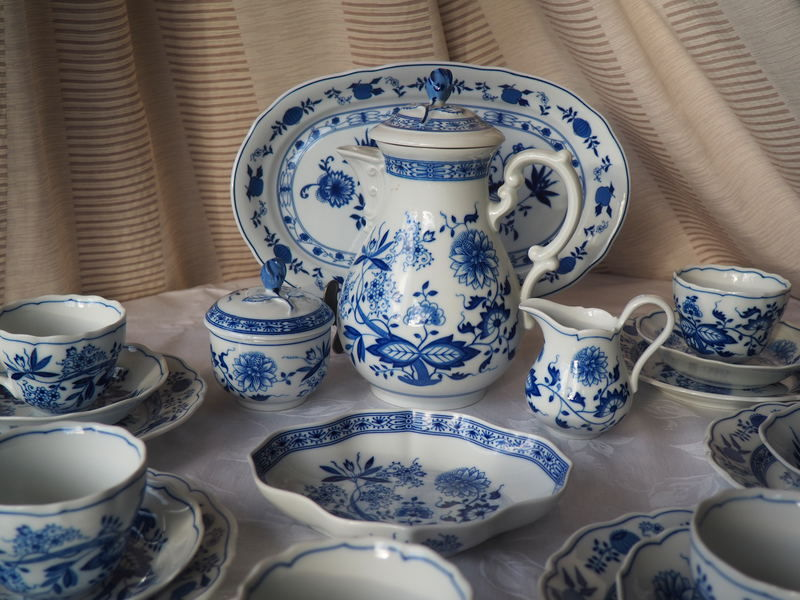
Therefore, he becomes very sad when he cannot drink from beautiful cups on the street or in the library, which he often goes to. He has to take a thermos with him, which is many times different from his favorite cups.

11 Comments
Zhang/张 XiaoYu/潇予 · October 30, 2024 at 7:52 am
We read your design brief and learned about your grandfather’s experience, and we feel our sincere admiration for him.
But we now have some questions to ask you, whether the last product you need is a beautiful cup?
Do you still expect any other features?
Do you like to have any change in appearance?
Is there any difference with the normal cup?
(Do you want a thermos cup or a normal cup. Because we’re not sure if your favorite tea is hot or cold?)
Zhang/张 XiaoYu/潇予 · October 30, 2024 at 8:04 am
By the way, we are curious about the custom of “not serving tea through the door by hand” in the post because we can’t imagine how to serve tea into our mouth without our hands.
Can you share what the teacup my grandfather usually brings out looks like?
What is the usual appropriate capacity?
Does the tea usually need to make tea leakage?
Do you drink it directly or pour it into another small container?
(It would be better if there was a picture of the tea-making process, love you.) Does drinking water use a straw and so on?
Do you prefer us to use some Russian elements and patterns or Chinese style elements?
We are really looking forward to your response.
ranokirgizbaeva · November 6, 2024 at 11:08 am
Hi💖, We’ve discussed these questions before in our chat. I thought it would be good to post the answers here so other people can learn from them.
-Whether the last product you need is a beautiful cup?
We would like to see a cup, which is working as thermos. Or a thermos, which is looking like a cup and have a cup on top
-Do you still expect any other features?
The final product must maintain temperature
-Do you like to have any change in appearance?
It would be great if the final product didn’t look like a regular thermos, but had patterns or an unusual shape
-Is there any difference with the normal cup?
It is durable and will not break. It also holds the temperature longer.
-(Do you want a thermos cup or a normal cup. Because we’re not sure if your favorite tea is hot or cold?)
Thermos сup. It would be good if there was place which is bring tea hot in bottle, but have opportunity to let it cool down in cup.
-By the way, we are curious about the custom of “not serving tea through the door by hand” in the post because we can’t imagine how to serve tea into our mouth without our hands.
In principle, it is not customary for us to greet or pass something to people if they have not crossed the threshold of the house. Since it is generally believed that an evil spirit or a person with bad intentions cannot cross the threshold and enter the house
-Can you share what the teacup my grandfather usually brings out looks like?
He has lots of kinds of cup. So it is hard to show all of them.
-What is the usual appropriate capacity?
Around 1-2 litres
-Do you drink it directly or pour it into another small container?
We would like to be able to drink directly and from a cup that would be connected to the tea storage part. It would also be great if it could be conveniently carried with you outside or to the library. So it will have something like bag only for “thermos” and some sweet(candy or cookie).
-(It would be better if there was a picture of the tea-making process, love you.)
You want to use the way we do with samovar or how we do it in daily life?
-Does drinking water use a straw and so on?
We don’t need a straw
-Do you prefer us to use some Russian elements and patterns or Chinese style elements?
We would like to see a Chinese style. Because Maria’s grandfather’s dream is to visit China.
Nevra Bahar · October 31, 2024 at 8:30 pm
Hello! I’m Nevra from Team 12 at METU. Even though I’m not on your paired team, I came across your post while exploring different blogs, and I wanted to leave a comment. Our group is called Teasigners, and I was really delighted to read about the tea culture you shared in your post. It’s wonderful that we can connect over tea! Wishing you great success in your process! And, hope so you’ll find best-tea solution 😀
ranokirgizbaeva · November 6, 2024 at 10:40 am
Hi. That’s very nice to hear. Thank you so much❤️.
zeynepuylulkaradag · November 5, 2024 at 6:47 pm
Hi, I’m Eylül from Team 10. I was browsing other briefs and yours caught my attention. I believe Turkey and Russia are similar in their love of tea. I love your traditional patterns and cups, they look very elegant. Maybe you can specify some characteristics of the product you want in terms of size, material, etc. I love this brief! This product will be one of my favorites! 🙂
ranokirgizbaeva · November 6, 2024 at 10:46 am
Hi. Thank you very much for such a wonderful comment🥰. Since we want something universal and reliable, the material will most likely be metal. The size is not too big, so that it is convenient to carry and use.
yagmurcotuk · November 6, 2024 at 1:41 pm
Hi everyone, I’m Yağmur from Team 10. I absolutely loved the visual elements and the research you incorporated into your project brief! The historical examples you used were incredibly insightful and really brought the traditions to life. It’s clear that a lot of thought went into understanding the roots of these practices, and it made the whole concept even more impactful. Your ability to weave together history and modern creativity is impressive, and I’m excited to see how this idea evolves!
biancacastaldo · November 12, 2024 at 9:33 am
The brief is full of information but in our opinion it goes on too long in the initial part and is scanty in the final part where it should be more precise.
In fact, reading it we understood little, with difficulty what their request was.
What do they want? A creative cup?
If so, what are the grandfather’s tastes?
Zhang/张 XiaoYu/潇予 · October 30, 2024 at 8:06 am
We have now raised some questions about the customer project briefing, and we have some preliminary ideas for the personal design, and we will issue our preliminary design briefing on the evening of the 31st.
Design Team 06 Initial Design Concepts – Design Team 06 | The 2024 Global Studio · October 29, 2024 at 5:57 am
[…] Hello Team 06, where are your Initial Design Concepts addressing your Client Project Brief? https://theglobalstudio.eu/2024-06/2024/10/28/team-18-brief/ […]