
PROJECT BRIEF
For your project we want you to design a storage unit for winter preparations. We will be explaining what kind of aspects you should be focusing on.
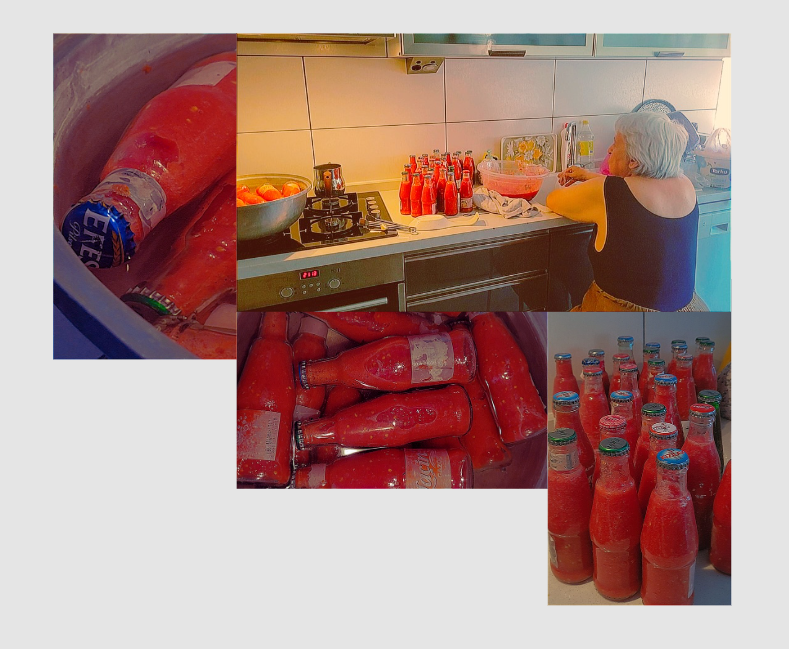
(This is Yağmur’s grandmother Hacer, preparing foods for winter.)
DESIGNING WITH SCENARIOS
Winter preparations in Turkey are traditional practices that help preserve food from the summer for the harsh winter days.
These practices are a form of cultural transmission, typically passed down to younger generations by elderly family members. The busy days of preparation allow family members to bond while enjoying the process. It’s not just family members who participate; close friends and neighbors also gather in the last days of summer to gossip, share their latest adventures, and celebrate the small joys of life. In many households, these final days are spent preparing foods like tomato sauce, drying vegetables, and stringing peppers on balconies. This process symbolizes cooperation and unity in Turkish culture, and it is important to understand how these practices are both produced and consumed within Turkish households. Due to Turkey’s cultural and geographical diversity, the ingredients used in these preparations vary from region to region.
The most common winter preparations include making homemade tomato paste and jam, drying eggplants, peppers, and other vegetables, and making pickles.
PREPARATION PROCESS OF WINTER FOODS
- Set goals for which products to preserve (e.g., vegetables, fruits, pickles, jams).
- Harvest ripe vegetables and fruits or purchase them from local markets.
- Wash and sort produce thoroughly, removing any damaged parts.
- Choose a preservation method:
Canning: Chop produce, then sterilize and store in jars.
Pickling: Prepare a salty brine to preserve vegetables.
Drying: Sun-dry vegetables to remove moisture for long-term storage.
Jams and Preserves: Cook fruits with sugar to create jams or preserves.
5. Store preserved products in a cool, dark, and dry place.
6. Incorporate preserved items into meals throughout the winter for healthy and delicious nutrition.

USER PERSONA
The main intended users are elderly people/grandparents in the family. We especially want you to focus on elderly people living independently.
The main goal here is to design a product solution that elderly people can use on their own without needing any help.
You can do interviews with your grandparents and ask them what food preparation represents for them and how they would hypothetically enjoy the process.
In the research part, you can focus on questions like:
- In what kind of space do they store the foods?
- How much space should the solution unit cover? Consider an average apartment/house.
- Which movements do your grandparents make? Are there any physical obstacles in the place they are storing/ making food? What kind of solutions can be made?
PROJECT OBJECTIVES
The product you will be working on should reflect cultural significance, cooperation, and unity. Here are some steps you should be considering while designing your solution.
- Identify Key Winter Storage Needs
Storage Conditions
Consider how these foods need to be stored—cool, dry, dark places are ideal for many preserved items. The prepared foods do not need to be stored in a refrigerator because of the preparation and preservation methods.
Organization
Grandparents in Turkey collect empty jars, lids, and soda bottles throughout the year. This behavior is a good example of a sustainable decision that is unconsciously made. The product should offer separation of empty and full containers as well as lids with different sizes. You can also consider how to separate different items (jars, dried goods) within the storage unit. Dividers or compartments could help keep things orderly.
Accessibility
For elderly people, ease of access is crucial. How often do they access these stored goods? Can the unit be opened, closed, or moved without much effort?
Portability
Since the unit needs to be portable, consider wheels or handles that allow it to be easily moved to different areas, such as balconies or kitchens, while still maintaining appropriate storage conditions.
Material Choice
The storage unit should be made from materials that can help maintain a stable temperature, such as wood or insulated plastic.
Ergonomics
Keep the height of the unit at a comfortable level to avoid excessive bending or reaching. Compartments that are frequently accessed should be positioned between waist and shoulder height to minimize strain on the back or joints.
Lightweight Materials
Ensure that the materials used are lightweight, making the unit easier to move and use. Incorporate handles that are ergonomically designed for a better grip, particularly for users with weaker hand strength.
Size
The product you will be working on should not cover too much area for an average Turkish kitchen. Depending on your product it can either fit in a cabinet, or it can be a separate portable unit. However, we prefer it to be a separate unit so it can be easier for you to design also. The height and the width of the product should not exceed 150 centimeters.
Cost Expectation
The product should be in an accessible price range for most of the population. It should cost around 1000-1500 Turkish Liras. (25-40 Euros)
2. Evaluate Existing Storage Solutions
You should do market research. But here are some examples of storage units:

Tip: Transparent sections or labeled compartments could be included so that users can easily see where everything is stored without having to open each compartment.
CULTURAL BACKGROUND
Elderly People in Turkish Culture
Elderly people play an important role in Turkish culture, representing inherited customs and values. Their significance is linked to various facets of Turkish family and social life, emphasizing authority, wisdom, and respect.
Respect
People are taught from a young age to respect older people, which includes standing when they enter a room, addressing them with respectful titles (such as “Amca” for uncle, “Teyze” for aunt, or “Dede” for grandfather), and listening carefully to their advice and stories.
Younger people are expected to kiss the hands of elderly family members as a show of respect, particularly during holidays and family gatherings.
Family Structure and Role of Elders
Elders have a crucial role in family life. They are often responsible for making decisions, raising children, and upholding customs. In addition to handing down cultural customs, tales, and ideals, many older people assist in caring for grandkids.
Wisdom and Storytelling
In Turkish culture, the elderly are often seen as the keepers of cultural memory and traditions. Their knowledge gathered through life experience, is considered valuable for younger generations. They frequently share historical knowledge, folk tales, and advice on moral or practical issues, which is a way of preserving cultural heritage.

HABITS
Love of Animals
In Turkey, stray animals are deeply loved. they are seen as blessings from God. There is a saying in Turkey “A person who does not love animals is not capable of loving humans.”They are often fed at the entrance of apartments and in parks. People make little houses for them to stay during winter. Elderly people are fond of them too. Especially cats, are more kind to elderly people and follow them around.

Listening Traditional Music
Elderly people love listening to “türkü”. Türkü refers to folk songs originating from music traditions within Turkey. Some of the most popular türkü are:
Sevda Türküsü by Grup Yorum
Grup Yorum – Sevda Türküsü I Cesaret © 1992 Kalan Müzik
Karlı Kayın Ormanı by Zülfü Livaneli
Zülfü Livaneli – Karlı Kayın Ormanında @livanelizulfu
Gelevera Deresi by Kazım Koyuncu and Şevval Sam
Şevval Sam & Kazım Koyuncu – Gelevera Deresi [ Karadeniz © 2008 Kalan Müzik ]
Ahirim Sensin by Neşet Ertaş
Haydar Haydar by Ali Ekber Çiçek

Afternoon Tea and Turkish Coffee
Tea (çay) plays a significant role in Turkish culture, and elderly people often gather with family or neighbors for tea sessions throughout the day. These gatherings are social and involve conversations about daily life, family matters, and local happenings.
Turkish coffee is a rich, strong, and unfiltered coffee traditionally served in small cups. It’s brewed slowly over low heat, creating a thick, flavorful drink with a fine layer of foam on top. Turkish coffee isn’t complete without a little fortune-telling fun! After finishing the coffee, the cup gets flipped upside down, and as it cools, someone takes a look at the coffee grounds and playfully predicts your future. They might say something like, “Hmm, I see a big journey ahead… or maybe it’s just a quick run to the market!”

Handcrafts
In Turkish culture, handicrafts are highly valued, and many older Turkish citizens still contribute significantly to the preservation and transmission of these age-old talents. A few of these handicrafts have been around for generations and are intricately linked to local customs, history, and everyday life. The following are a few of the most well-known handicrafts that older Turkish citizens frequently perform:
Knitting and Crocheting (“Örgü” and “Dantel”)
Knitting (Örgü): Many Turkish women, particularly the older ones, are adept knitters. They produce a wide range of knitted goods, including cardigans, sweaters, scarves, and socks (called “yün çorap”). Traditional knitted wool socks can have complex designs and vibrant colors.
Crocheting (Dantel): Many older women also crochet complex patterns or create lacework to decorate home furnishings like napkins, tablecloths, and curtains. Towels with lace edging (called “havlu kenarı”) are especially common. Gifts of these exquisite works of art are common, particularly at weddings and other special events.
Carpet and Kilim Weaving (“Halı” and “Kilim Dokuma”)
Whereas kilims are flat-woven and used as furniture covers, tapestries, or rugs, carpets (halı) are often thicker and utilised as floor coverings. In addition to geometric patterns, florals, and traditional symbols that narrate tales or symbolise family history, the designs are frequently geographically specific.
Pottery and Ceramics (“Çömlekçilik”)
Pottery is still made by older craftspeople in areas with rich clay resources. For instance, Avanos, a village in central Turkey, is well-known for its pottery, and many older men teach the next generation of people how to make it. Bowls, jugs, and decorative ceramics are examples of handmade pottery, which frequently has traditional patterns and decorations.

We hope that you will enjoy the project. If there are any questions please feel free to ask! We are looking forward to working with you!
Love, Team 10
Hello Yağmur, thank you for sharing your Client Brief on behalf of the Team 10.
I assume that none of the included pictures are yours or your team members. If this is the case, you NEED to acknowledge this by indicating the source. Otherwise, it looks like that these are your picture which is stealing someone’s intellectual property.
As future professional designer the Intellectual Property is extremely important to protect your work as I doubt that you would want other to use your work without compensating you for your time and your creative input. Am I correct?
Erik
Hi Eric,
Thank you for pointing that out. It honestly slipped past us, but we’ve updated the brief and made sure to add the sources for all the images. We totally get how important intellectual property is, and we definitely want to respect and acknowledge others’ work, just as we’d hope others would do for ours in the future. Appreciate the heads-up!
Hi Girls!
Some things we discussed on the meeting we had on Sunday:
– Glass Jars are the most used containers. We have to protect them from sunlight.
– Cost efficient
– We need a range of dimentions for the product or the place where is gonna be located. A day in a life/week in a life would be awsome to understand the process of how do they make the preserves (also the pre and post process of that)
– We decide if the product will have wheels, it is gonna get pulled. Also the asthetic is our choise (color, fun, turkish patterns…)
– We have to take into account that the empty jars will be reused and the device must mantain the preserves in order (easy to find the things), but in a compact way ¿maybe we want to make it foldable?
– Note: Turkey is a multicultural country with a range of ecosystems and temepratures. Ingredients used for preserves change depending on the region: olives, pumpkins…
Hi guys, well done your brief is very clear and the theme is very interesting.
We understood what you want
You were very precise in fact we who did not know this tradition understood everything and you captured our attention
Hi! This is Zeelaf from METU Team 3 / Design Team 11. I just wanted to say that great job on this brief! It’s clear and captures the cultural significance of your proposed project beautifully. As aspiring industrial designers, focusing on accessibility, ergonomics, and portability will be key for your target users I believe. Maybe consider adding a bit more detail on how users interact with the unit in daily use—like how often they access it or move it, and how they organise different food types or other items, since the type of things being stored often influences the form and material of the product. That could help refine the design for both functionality and ease of use. Looking forward to seeing the solutions for this project! 🙂