
tereré
Context
We live in the extreme south of Brazil, where there is a culture of drinking a type of tea called chimarrão, or mate. Among teenagers, this culture is still popular but with some changes. While chimarrão is originally a hot drink, teenagers often drink it cold, mixed with juice or soda and call it tereré.
Tereré has its origin from the Guaranis, an indigenous group original from South America. There are rumors that people began drinking it cold during the Chaco War, from 1932 to 1935, to avoid drawing the enemies’ attention while lighting a fire to boil water for chimarrão.
However, the origin is traced back to indigenous people who used maté leaves to filter water from the rivers, preventing schistosomiasis disease before the 1500s.
Nowadays, it is enjoyed as a form of leisure and socializing among friends and family.

Some customs:
– Tereré is usually drunk in circles;
– The person who serves others is the same one who prepared it;
– In your turn, the drink must br drunken until the end before you pass it to the next person.
How to prepare
Tereré is prepared in the following way:
1. In a thermos/cooler, add water and ice
2. You may add juice to the water. Powdered juice is commonly used for practicality
3. In a gourd or cup, place the metal straw right in the middle
4. Fill the gourd with herb until it is half full.
5. Pour the water slowly
6. It’s ready to drink!

Problems
– When drunken on the beach, it’s common to get sand on the cup
– A cooler isn’t very practical to carry, but smaller thermoses don’t last long; they hold enough for about 6 tererés.
– Sometimes, depending on the material of the gourd, the tereré can get too hot.
– When drunk with lemon juice (the most common one), oxidation of the straw occurs, as it’s made of metal.
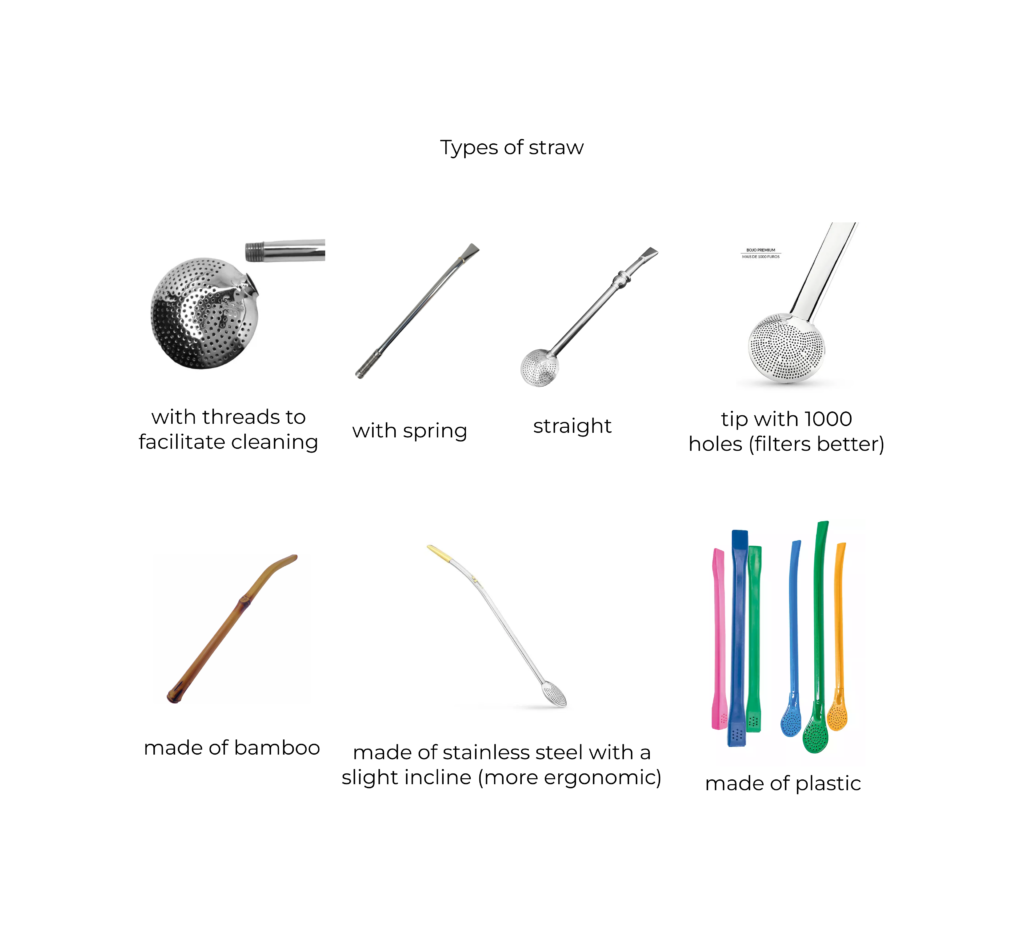
– Some straws have holes through which the juice enters. When these holes are too large, the herb is allowed to enter and often causing clogging.

Design requirements and maximum cost
Given the problems presented for drinking tereré, it is necessary to design a bottle, cup, and straw for the beverage with attention to the following conditions:
– Portability and adaptation: The tereré kit must be easy to transport and adapt to the location.
– Tradition: It is important to maintain the traditional aspect of the drink.
– Temperature: The bottle carrying the juice should keep it cold for several hours, and the cup should not heat up from hand contact.
– Durability: Considering that the product will be used frequently, it is important that it is durable and does not deteriorate with use.
– Safety: The straw must not have overly large openings for the safety of those drinking.
– Efficiency: The bottle used to transport tereré must not leak.
– Price: The cost of the kit should not differ considerably from market value, which ranges from 60 to 170 reais.
– Additional accessories: Many straws come with a small brush to clean their interior, which is not always efficient.
Please if you have any questions, don´t hesitate to ask!
Kisses, Itty Bitties!
I took a quick look at your post and it seems to be an interesting research topic! 🙂 Thank you for your sharing, but we may need to look into it in a few days and get back to you if we have any questions. 😘
Hello Team 27, can you please help for your Designer about the users? Who are they? Where do they live? The Client Project Brief was meant to be specific about your grandparents problems. Perhaps, your grandparent do go to the beach and during this tea, but from your Client Brief there is no sense who the user are.
Also, reviewing your Client Brief I cannot get a sense of the cost of the various items.
The Design Team 02 will ask you more questions. Please respond as soon as possible as the next week they will need to share the initial design ideas with you.
Erik
Hey Erik!
I think we have a miss-understanding, our professor specifically told us that the brief should be about little thing that make us happy!!!! About the information missing we’re going to be working on that, but if we need to change everything, to make about our grandparents there is going to be a delay even bigger on the deliveries.
Please let us know, with clarity what is our next step.
Well your grandparents drink this too, is it correct?
Which users have you observed, and/or interviewed to identify the given problem? Or have you just made the problem up amongst your team?
As I indicated above I like the area but I have no sense of the user(s) and therefore it is difficult to conduct a user cantered design approach.
Plus, all the photos you have provided are from the internet rather than investigating what does ‘your’ use.
Erik
Hello Hanna, as you are already a little delayed we have no time for your team to restart the stage one of the project. This week the teams need to deliver the initial design concepts addressing the Clients Project Briefs.
What is missing in your Client brief are the users. Who are they? What do they do? Where do they live? and so on and so on.
I assume you have based the problem on somebody. If so who are they?
Erik
Hello, Team 27, we want to know who is the specific user of the product we need to design, whether he is male or female, how old he is, what are the usage scenarios and what are the aesthetic preferences. ⊙▽⊙ We wish we could learn more. ʕ ᵔᴥᵔ ʔ
Hey Qian!
We’re working on answering all of your questions 🙂
As it may seems we might have to change a lot of stuff because of the miss-understanding, as mention in my comment here for Erik! I think we could schedule a call to talk more about it.
We’re going to be working hard to send you all of your questions by Tuesday, if that is okay by you guys!
Sure! Thank you for your reply.😊
Hello friends of Group 27,we have a few questions for you.(@_@;)
As for the custom you mentioned, we are not quite sure whether the person preparing the invitation is responsible for preparing this drink for everyone, and whether everyone drinks this drink in a circle around the city, and the third mentioned that after drinking, it is passed on to the next person, whether everyone takes turns to drink from their own cups or something.
As for the production steps of this kind of tea, we are not sure whether you can introduce the specific production steps together with corresponding pictures or videos for each step.
As well as the picture of the container you provided us, could you put the cup and straw together with the cold pot for comparison, so that we can have an understanding of the capacity, or you can tell us the specific capacity (usually how much a person drinks and how much is prepared in total)?
And the second question on the issues page of the design brief, “6 tereres” refers to six cups or six units of what?
Although there are many questions, but you do not need to rush to reply, please follow your pace, looking forward to your answers. o(*^@^*)o❀
Hey Xinhe!
I’m gonna try to answer all of your questions!
1 – It is a costume that whoever does the Tereré (prepares it), serves it to the rest. The serving is just pouring water on the cup and passing to the next person. It’s is not a big deal, not always works like that. But I guess the person who is serving need to want to be serving the others, that’s why it’s always the one who is more excited and had made the Tereré.
2 – It’s not always a circle! We could be watching TV side by side and drinking it, if there are more people it tends to be a circle to chat better, but if there is less people drinking it is not.
3 – It’s the same cup for everyone (that’s why during COVID, Chimarrão and Tereré were banned from the public locations), so imagine there is a line waiting to drink, and after everyone had one, the line repeats again and again and again. The point is: the cup is filled, with about 200ml of juice/water, and you just pass to the next one if you had drank everything, not just a sip.
4- As for the rest we’re going to send you some pics, or we could show you during a call, let me know which one works the best for you guys.
The 6, is referring to six cups of Tereré (we could refil and drink it 6 times or 1 drink per person if drank in a group of 6)
Let me know if I helped!
🙂
How large are these cups? How much do they cost? What are they made of?
Do you have a favourite cup?
Does your grandma has her favourite cup?
What about your grandfather?
Erik
Hello Hanna, would you mind sharing photos of your team doing the tea preparations, pooring the tea and drinking it at the beach?
Thank you, Erik
Hi Hannah, thank you for your reply, it was very helpful to us!👍
Dear Friends of Team 27:
Hello! We have been waiting for your new progress report and sent you two emails asking about it the other day, but we don’t know if you didn’t receive the emails and haven’t replied.🤔
Therefore, I will also post this email on the website, hoping that you can see and reply.
We would like to have a Zoom meeting with you to discuss the design project today. Do you have time? Please reply to the email. Thank you for your cooperation!😊
Hello! I’m Nevra from Team 12 at METU. Although I’m not part of your paired team, I came across your blog while browsing different posts, and I couldn’t help but reach out to share my thoughts.
I had never heard of Terere before, and reading through your brief sparked my curiosity! It provided me with the opportunity to do a bit of research online, and I must say, I found it really nice. I hope one day I’ll find a chance to try it. Based on what I’ve read in the comments, it seems you had to make some changes to your brief. However, it’s wonderful that you sparked my interest in Terere! Thank you for that.
Wishing you all the best in your process! I look forward to seeing how your project evolves! 🙂
Great idea, this brief is very original as it is related to Brazilian culture. it is very interesting to get in touch with your culture and find out the ways you use to socialize. The proposed brief is good, linear and precise, it can have various solutions and you can use creativity. Designing for a drink seems trivial, but it is actually an extra push to drink more of it!