Hello Fabi,
We have carefully reviewed the three geriatric medication management solutions you proposed: the “Scented Necklace,” “Portable Pill Case with Built-in Brush” (formerly referred to as “Bunker”), and “All-Day Wearable Clip.” Overall, these designs closely align with the core needs of elderly users—namely, safe medication administration, portability, and emotional comfort.
In particular, we are impressed by two standout strengths: the innovative concept of Solution 1, which integrates medical functionality with everyday jewelry, and Solution 3’s unwavering focus on ultimate portability. Both address the practical pain points of the elderly demographic with remarkable precision. We fully endorse your design direction and believe it demonstrates a deep understanding of the target users’ needs.
Below, I will focus on providing feedback on the content of first selected plan.
- Strong Function Integration: It multi-dimensionally integrates the pill box, fragrance compartment, massager, and intelligent alarm system. This meets the elderly’s composite needs for medication management and physical/mental relaxation (fragrance regulates mood, and massage relieves fatigue), realizing the goal of “one item with multiple functions”.
- Elegance and Practicality Balanced in Design: Combining traditional textile craftsmanship (embroidery decoration) with modern intelligent technology, its appearance resembles an exquisite accessory. This weakens the “coldness” of medical products, conforms to the elderly’s pursuit of aesthetics and emotional comfort, and enhances their willingness to wear it.
- Humanized Reminder Method: Through the dual prompts of “red light + fragrance” (a soft red light indicates medication time at the scheduled hour, while a soothing fragrance is released simultaneously), it adapts to the potential visual and memory decline issues of the elderly, reducing the risk of medication confusion.
1.Optimization of the core functions of the medicine box
- Supplementary Notes on Unspecified Issues
The existing design fails to specify the capacity specifications of the pill box, and the opening-closing mechanism as well as sealing performance lack elderly-friendly considerations. Elderly users often suffer from hand joint stiffness (e.g., arthritis), and complex opening-closing structures (such as rotating, snap-on, or pull-type) will significantly increase the difficulty of use; if the sealing is insufficient, it may easily cause the medicine to become damp and deteriorate, directly affecting the stability of the medicine’s efficacy.
- Optimization Solutions
Opening-Closing Structure: Adopt a dual-mode design of “magnetic attraction + press-to-pop-open” to replace the traditional rotating, snap-on, or pull-type structures. This minimizes the need for hand force to the greatest extent and is suitable for the elderly with degraded hand functions.
Sealing Performance & Material: Use food-grade PP material as the main material, and add silicone sealing rings at key internal positions to form a dual moisture-proof protection, preventing the medicine from getting damp.
Capacity & Partitioning: Divide into independent partitions according to “morning, noon, and evening” (with a clear capacity matching the single dose of medicine). Each partition is marked with enlarged fonts of size 14 or above, and paired with intuitive icons (sun = morning, moon = evening) to solve the problem of medication confusion caused by poor eyesight in the elderly.
- The intelligent reminder function is improved
Remaining Medication Reminder: Add a “low medication warning” function. When the remaining number of pills in any partition is less than 2, a yellow light prompt will be triggered simultaneously to prevent users from forgetting to replenish their medication.
Medication Time Reminder: Adopt a triple reminder mechanism of “LED light + vibration + sound” to adapt to the different sensory conditions of the elderly (such as hearing loss and visual impairment). This reduces the risk of missed doses caused by the failure of a single reminder method and ensures regular medication intake.
2.Optimization of the fragrance compartment function
Aroma Adjustment and Personalized Adaptation: Add an “aroma concentration adjustment” knob with three adjustable levels: low, medium, and high; at the same time, provide replaceable fragrance modules (such as sleep-aiding lavender, refreshing citrus), to meet users’ needs in different scenarios such as at home and when going out, while taking into account personal preferences.
Remaining Quantity Visualization: Design a “fragrance remaining quantity viewing window” using transparent materials to allow users to intuitively observe the remaining amount of fragrance, avoiding the loss of auxiliary reminder functions (such as atmosphere prompts for medication scenarios) due to the depletion of fragrance.
3.Improvement of potential safety hazards
Regarding the existing placement method of the massager, it is necessary to optimize its placement structure or add protective designs: the current placement method may cause physical collision injuries when the elderly accidentally fall. It is recommended to reduce safety risks and improve usage safety through fixed brackets, rounded corner treatment, or retractable designs.
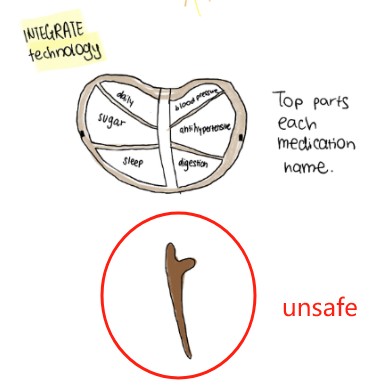
Feedback and Suggestions on Plan 2
- Internal Structure
The interior of the medicine cabinet is divided into 3 independent compartments corresponding to “morning, noon, and evening”. Each compartment is equipped with a magnetic pop-up structure (which can be opened with a light press, reducing operational difficulty) and labeled with medication information in extra-large font (≥16pt) plus raised textures—catering to both elderly users with normal vision and those with visual impairments.
- Multi-Scenario Carrying Options
In addition to being held by hand, it is equipped with a “magnetic lanyard buckle” (can be hung on bag straps or waist belts) and a “clothing clip” (can be clipped to clothing hems or collars), enhancing the flexibility of carrying.
Feedback and Suggestions on Plan 3
- For the clip part, it is necessary to ensure that when clipped to clothing, it will neither slip off nor damage the clothing or constrict the skin due to excessive clamping force. Meanwhile, an “anti-misopening safety buckle” should be added— the clip can only be opened by pressing both sides simultaneously to prevent accidental detachment.
- A “detachable compartment function” can be added, allowing users to flexibly combine compartments according to their daily medication needs (e.g., carrying only the morning and noon medication compartments), further enhancing the flexibility of portability.
- The LED light should be equipped with “brightness adjustment” (with daily/night modes). In night mode, it automatically switches to soft amber light to avoid eye irritation from strong light.
I hope these will assist you in deepening the plan further.