Hey! Here we have our concepts for this challenge.
When thinking about how to use the least space possible for the design, I realised that there is a lot of space near the ceiling. This space is not used, and it could be a good opportunity for placing the shoes there. Moreover, it would not use space on the floor and would not be in the middle, so people would be able to walk under it without disturbance. Regarding this, the idea is to design a product that can store shoes near the ceiling.
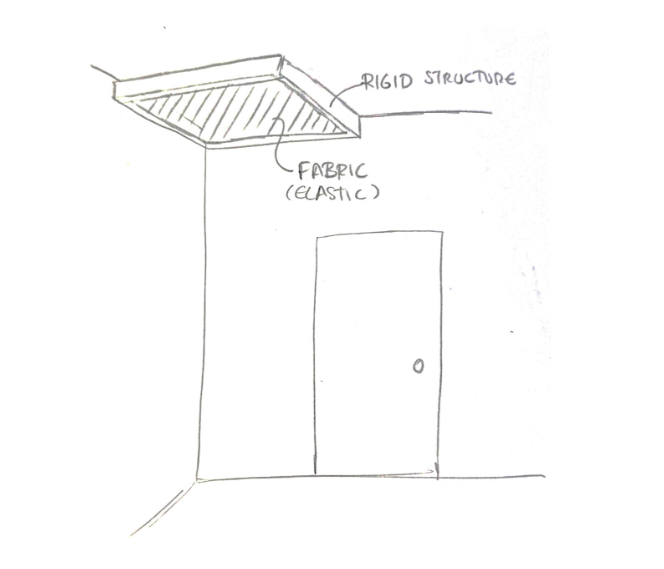
In the first sketch we can see how the product would look without any shoes in it. It has a rigid structure, forming a square. This structure is placed under the ceiling. Attached to this structure, it has a fabric that is elastic and, in this case, it is horizontal because it has no shoes inside.
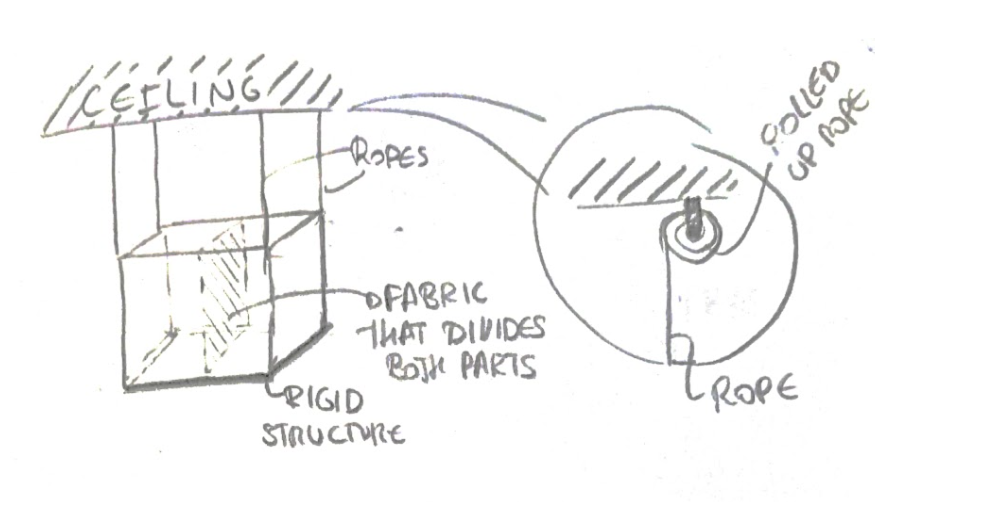
When a person arrives and wants to store their shoes, they have to lower this structure. The mechanism for making it go down will be discussed later, as there are different options available. The system consists of four ropes, one in each corner, and the four of them attached to the structure and rolled up in the ceiling. When the structure gets down, this rope is rolled down, so the storing part becomes accessible for the people. There are two different sections, one on the right and other on the left. It is a symmetrical product. In the central part, there is a fabric that divides both parts.
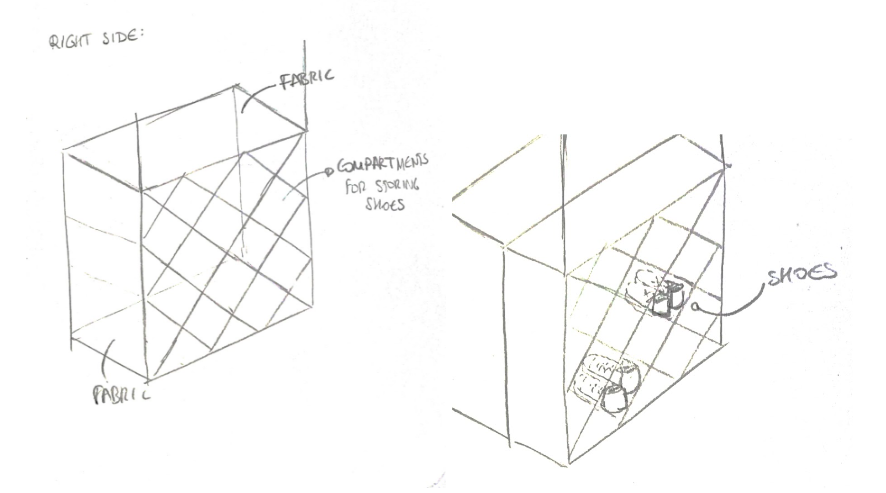
We are going to analyse the right side, but the left one is equal. Both parts, the front and the back ones, are also made of a fabric that is also elastic. They act like a wall so shoes stay in their place, and there is also a fabric at the top that acts like a ceiling. This fabric will also avoid the ceiling from getting dirty with the shoes. Looking at this, we can say that we have “a room” where all the shoes will be stored. In order to organise all the shoes, there are also some elastic fabrics that form an angle of 45º, creating some squares with these parallel and perpendicular fabrics. These fabrics are also elastic, so any shoe size can fit in the compartments.
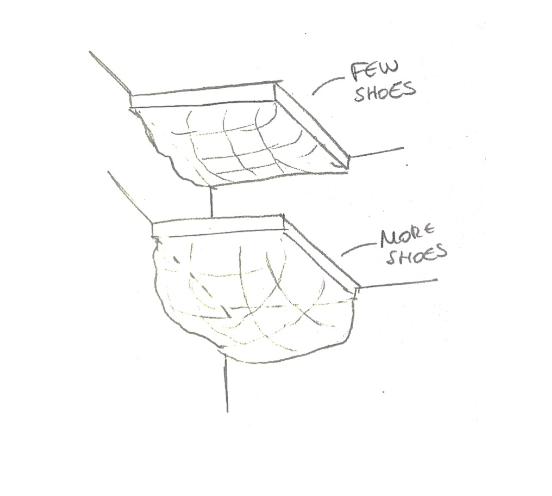
Once all the shoes are inside the compartments, the structure is raised. The rigid part gets up to the ceiling. Meanwhile, the inside fabrics are folded, and as they are elastic, there is no problem with this. When the rigid parts arrive at the top, the shoes make the lowest fabric to stretch and it adapts to the number of shoes, acquiring the form of the shoes. This allows the product to use just the necessary space, being bigger if there are more shoes and smaller if there are less pairs of shoes.
For making the rigid part go up and down, there are different systems that could be developed. Some of them are manual, such as using a pulley and pulling the rope or turning a crank. However, as the target audience are elderly people, we consider that it might be difficult for them as they might not have the required strength. Taking this into account, the idea is to introduce a motor and make it automatic, so it gets up and down just by pressing a button.
ODEI | DESIGN TEAM 20
Actually, we found the general idea interesting, especially in case of using ceiling space as a place for storage. But as you said, the usage of system can be hard to use for elders. Because when there is a lot of shoe to be stored, the overall weight can make it difficult to pull, and it may require muscle strength which makes usage hard. Also, when we placed the shoes and pulled the system up, the shoes do not create an aesthetic appearance as they will weigh on the fabric due to gravity.